
A scorching summer across Europe has brought the urgency of climate action into sharp focus. Behind the scenes, the metal packaging industry has been making progress: according to Metal Packaging Europe, its packaging’s climate impact has already fallen by between 30 and 50% since 2002. Cleaner energy, more efficient manufacturing and closer collaboration across the supply chain are central to accelerating that progress.
Circular by nature
Metal packaging’s strong sustainability credentials are already appreciated by consumers. More than 65% of UK consumers believe cans are the most circular beverage packaging format, research by trade body Can Makers UK found last year.
That perception is well-founded, with a report from industry organisation European Aluminium and Metal Packaging Europe in 2026 revealing that the recycling rate for aluminium beverage cans across the European Union, United Kingdom, Switzerland, Norway and Iceland reached 76.3% in 2023, with the tonnage recycled increasing by 7% compared with the previous year.
The rise in recycling rates is in part thanks to initiatives such as Every Can Counts – an industry-leading not-for-profit programme that aims to encourage and enable consumers to recycle beverage cans and to promote the benefits of recycling – and the increasing number of European national markets that have introduced a deposit return system (DRS) on packaging. 19 countries across the continent are now running such a scheme, with more to follow over the coming years as DRS will become mandatory by 2029.
Regulation and producer-funded collection systems also play an important role in improving recycling rates. Across the EU, the Packaging and Packaging Waste Regulation requires collection systems to cover packaging waste from both households and businesses, including hotels, restaurants and cafés. Extended producer responsibility schemes help fund the collection, sorting and recycling needed to return these materials to productive use.
But there is room to improve the sustainability of metal packaging even further – and not just by targeting recycling rates. The Decarbonisation Roadmap, established by Metal Packaging Europe as the united voice of rigid metal packaging across the continent, provides a route for the aluminium beverage can industry to reach net-zero greenhouse gas emissions by 2050, across four pillars: aluminium sourcing, can manufacturing, transport and logistics, and recycling.
%
of UK consumers believe cans are the most circular beverage packaging format
%
of beverage cans recycled across Europe
Sustainable process
The industry continues to make strides forward. Across these pillars, innovations have been introduced to lower the overall carbon footprint of the package.
Aluminium production accounts for around two-thirds of aluminium beverage cans’ carbon footprint. Producing primary aluminium involves refining bauxite into alumina, then using energy-intensive smelting to turn it into metal. Increasing recycled content, switching to cleaner energy sources and adopting lower-emission production technologies are therefore central to reducing the finished can’s climate impact.
At the start of the can production process, canstock manufacturers have adopted new technologies. For example, aluminium producer Novelis has successfully trialled the use of hydrogen as a source of power. The initiative required new burners and regenerators to be installed, both of which are capable of operation with either hydrogen, or a blend of hydrogen and natural gas. By exchanging natural gas for the same amount of hydrogen, CO2e emissions can be reduced by up to 90% when operating a melting furnace, Novelis says.
The canstock manufacturer has also adopted another alternative to gas via its first electric pusher furnace – used to heat aluminium ingots before the rolling process begins. Switching to electricity will reduce annual emissions by around 4,500 tonnes CO2eq, and overall energy consumption by approximately 25%.
Last year, aluminium rolling and recycling company Speira started up a new recycling furnace in Germany, with a view to lowering emissions and increasing capacity. The furnace – nicknamed ‘Bernhard’ – holds up to 25 tonnes and is one of four furnaces commissioned at the company’s facilities in Germany. The system features modern burner and afterburner technology to optimise energy efficiency, while its design reduces heat loss via features such as the automatic charging process, and tapping with closed furnace doors.
Canmaking advances
Canmaking operations are decarbonising too, from how the plants are powered to the individual elements of the production process. Europe’s four leading canmakers have all defined rigorous emission reduction targets to be achieved by 2030, validated by the Science Based Targets initiative, covering both their operations and their wider value chains.
It’s clear that energy savings are already being made along the canmaking line, notably in traditionally energy-hungry processes such as drying and curing. For example, UV and UV-LED curing systems, and accompanying compatible inks, have enabled canmakers to switch from conventional heat-based curing in the can decoration process.
Manufacturers of drying ovens have innovated too: one major player has introduced hydrogen-ready systems, while another’s can dryer allows the use of natural gas, LPG, electric power, or a combination of those fuel sources.
Progress has also been made in leveraging renewable energy. One major canmaker recently installed solar panels at its beverage can plant at Seville, Spain, as part of its commitment to move to 100% renewable electricity across its operations by 2040. The canmaker is also running a programme of 20 sustainability goals to be completed by the end of 2030, and this summer announced it had achieved a 20% reduction in water withdrawal across its global operations, while increasing can production by 30%. Meanwhile, another leading canmaker has run all of its plants on renewable electricity since 2022, which the company achieved primarily through the purchase of SBTi-approved certificates.
Alongside onsite generation, European canmakers are also supporting renewable electricity projects through virtual power purchase agreements. These long-term financial arrangements help provide revenue certainty for renewable energy developers, supporting the expansion of clean electricity generation and helping scale up its availability to meet rising demand – from within the metal packaging industry and beyond it.
Smarter journeys
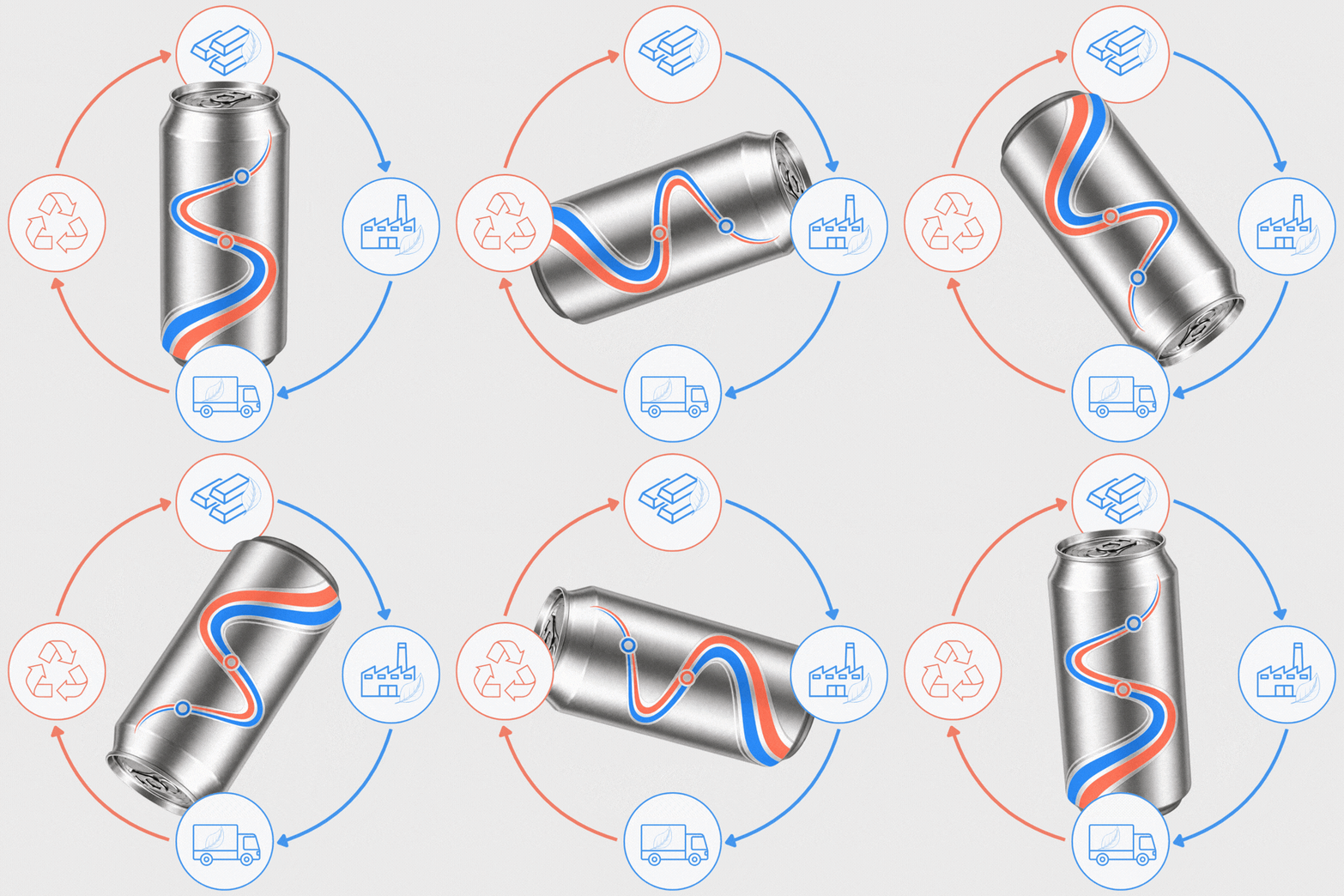
Logistics are also being optimised for sustainability. Several major canmakers are working with logistics and supply chain specialist Woodland Group to trial the use of alternative fuels and electric vehicle technology in a bid to further cut emissions.
While new innovation abounds, some of these energy-saving methods have existed for decades – and are ripe for replication elsewhere. For example, a soft drinks plant in Rugby, UK, and the neighbouring can plant run a ‘hole-in-the-wall’ operation, with finished cans being transferred directly into the beverage facility ready for filling. This simple but effective set-up, also seen in other locations, reduces the carbon footprint of the journey to effectively nothing.
There are many more examples throughout the canmaking industry of environmental performance being enhanced and optimised. From the initial canstock through to the finished product – and beyond that, as recycling recaptures energy and value – the can industry has much more to shout about than just the inherent sustainability of metal.