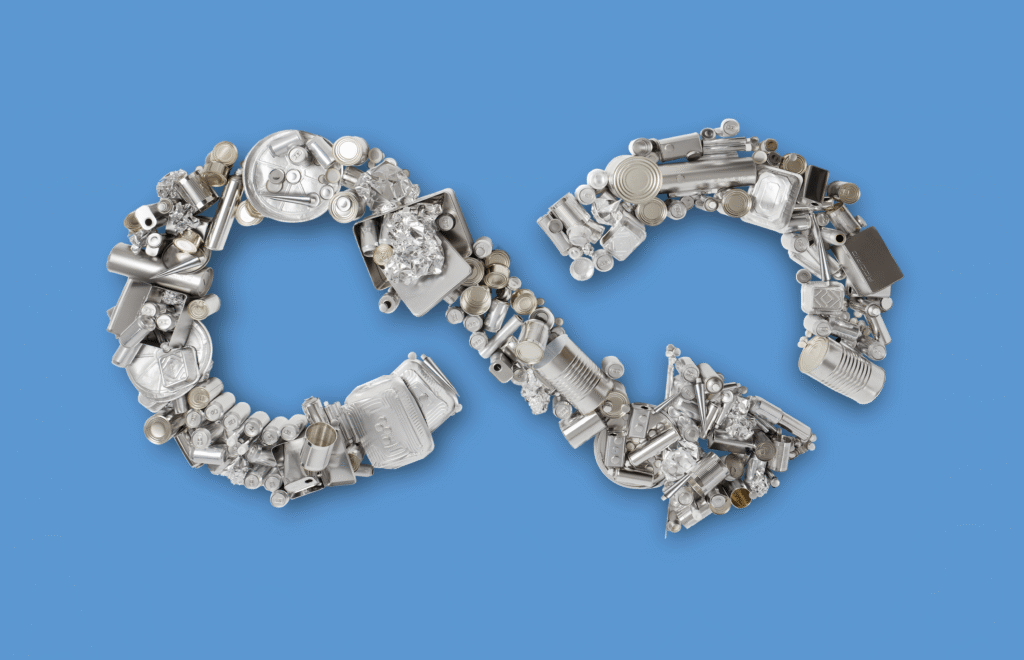
A Permanent Solution for Circularity in Europe
LCA Highlights Metal Packaging’s Long-Term Progress
The story of metal packaging in Europe is one of consistent, measurable progress.
The latest Life Cycle Assessment (LCA)¹ reinforces this positive trend. It is the most comprehensive LCA conducted for the European metal packaging industry, covering 1.5 million tonnes of steel cans and 1 million tonnes of aluminium cans produced by MPE corporate members.

The results show significant advances compared with the previous LCA²:
Climate change impact reductions:
- Aluminium beverage and aluminium food can manufacturing reduced GHG emissions by an average of 31%.
- Steel aerosol can manufacturing achieved a 14% reduction.
- Tinplate production in Europe achieved a 10% reduction.
Energy efficiency improvements:
- Steel general line can manufacturing reduced electricity consumption by 18%.
- Aluminium beverage can manufacturing reduced electricity consumption by 6% and heat demand by 15%.
- Steel food can manufacturing reduced electricity consumption by 5%.
- Steel aerosol can manufacturing reduced heat demand by 10%.
Material efficiency and lightweighting:
- Aluminium food cans are 19% lighter.
- Steel general line cans are 13% lighter.
- Steel aerosol cans are 10% lighter.
- Aluminium beverage and steel food cans maintained optimised lightweight profiles.
High-quality recycling remains one of metal’s greatest strengths. A 1% rise in recycling rates reduces the carbon footprint by an average of 1.4% across metal packaging formats.
Steel and aluminium are permanent materials that can be recycled forever without losing quality, making them essential to Europe’s climate ambitions and long-term economic resilience. As Europe advances its next phase of climate and environmental legislation, metal packaging provides clear evidence that circular systems can perform at scale.
Metal packaging delivers both quality for consumers and true circularity for Europe, a success story built on permanent materials that must be protected and strengthened.
—
1 – 2025 MPE Life Cycle Assessment Report, based on 2023 production data.
2 – 2022 MPE Life Cycle Assessment Report, based on 2018 production data.
—
📄➡️ Please click here to download a PDF version of the press release.
Supporting Materials
The 2025 & 2022 Executive Summaries, Methodological Report, GHG Emission Factors and Life Cycle Inventories (LCI) are included in the package of supporting materials.
The LCI allow users to import and replicate the life cycle of metal packaging in their own LCA. Two sets of LCI are provided:
- “G-t-G” refers to the “Gate-to-Gate” process of metal packaging manufacturing;
- “CtG+EoL” refers to the “Cradle-to-Gate + End of Life” process of raw material extraction, aluminium and steel coils production and transport, metal packaging manufacturing process, transport to fillers, and End of Life of metal packaging.
The Methodology Report enclosed in the LCI describes the scope, boundaries and implemented methodology of the LCA.
Note on LCI reference unit
The LCIs use a reference unit of “1000 units”, as indicated in the title of each process. In the flow inventories, the output flow is equal to 1 as it means 1 × 1000 units. Therefore, all calculated environmental impacts correspond to 1000 cans.
Some LCA software may not support this reference flow when importing the datasets and may automatically replace it with another unit (for example kg). Users should therefore verify the reference flow and ensure results are interpreted relative to 1000 cans.
Please complete the form below to access supporting LCA documentation:
What is an LCA?
The Metal Packaging Europe Life Cycle Assessment (LCA) studies identify the average environmental impacts and benefits of metal packaging manufactured in Europe throughout its life cycle.
The LCA covers the entire metal packaging portfolio, including beverage cans, food cans, aerosols, general line cans, closures and specialities. To allow stakeholders to incorporate the LCA of metal packaging into their product LCA, the Life Cycle Inventories (LCIs) of metal packaging are available for the life cycle (cradle-to-gate + End-of-Life).
The Metal Packaging Europe Life Cycle Assessment (LCA) studies are ISO 14040/44 compliant, and were conducted and peer-reviewed by independent international consultancy firms specialised in LCA practices